

By Alex Jack
In the moonlit embrace of the West African savannah, Chi, the young king of the roan antelope population, stood proudly. His sleek, golden-brown fur shimmered under the moon’s caress, and his regal horns, a testament to his lineage, gleamed. Chi’s gaze swept over his domain, a kingdom of endless grasslands where life thrummed with an ancient rhythm.
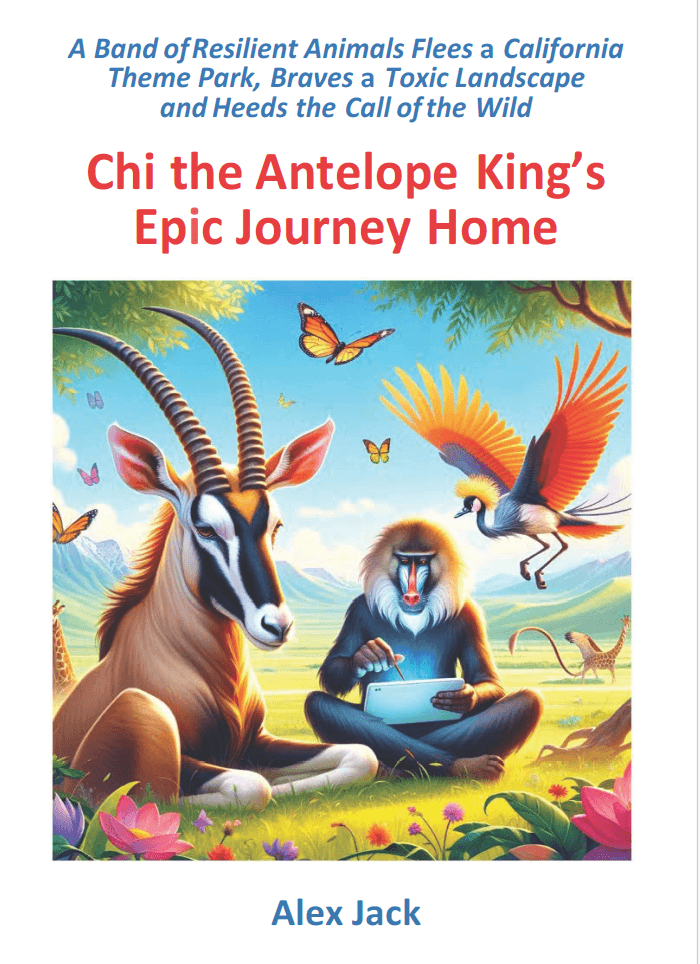
As the herd grazed peacefully, Chi moved with a graceful confidence, his keen eyes surveying the vast expanse of the savannah. He carried the weight of responsibility upon his broad shoulders, for as king, it was his duty to ensure the safety and well-being of his subjects.
Little did Chi, the young monarch of his herd, know that the tranquility of this moonlit night would be shattered, setting into motion an odyssey that would transcend continents and challenge the very essence of his existence.
As the herd grazed peacefully under the starlit sky, a faint tremor, unnatural and foreboding, shattered the serenity. Chi’s ears twitched, and his muscles tensed. The sounds of the night, once familiar and comforting, were now drowned out by the clamor of engines and harsh human voices.
“Stay close,” Chi murmured to Amma, his mother, whose wise eyes reflected the moonlight. The herd, sensing the unease of their king, gathered around him.
Suddenly, the tranquility was shattered by the rumble of approaching danger. Chi’s senses tingled with instinctive warning, and he raised his head, ears perked in alertness. In the blink of an eye, the abductors struck, their nets casting a dark shadow over the moonlit landscape.
Unbeknownst to Chi, a group of scientific researchers led by Robert Ott, the steely King of the Field Zoologists, had descend-ed upon the savannah, his eyes gleaming with pride in further-ing medical research and free enterprise. His soul had been tarnished by greed, and he anticipated the bonus he would receive for this challenging assignment. Over the years, Ott had made the transition from a big-game hunter of exotic and endangered species for wealthy patrons to a master trafficker of rare birds, mammals, and marine life for zoos, science labs, and sanctuaries. Armed with digital technology that surpassed the wildest dreams of Chi or his ancestors, they operated with a cold precision that betrayed the ruthless efficiency of their trade.
In the blink of an eye, the kidnappers struck when their electronic sensors detected Chi’s arrival at the riverbank. Surveillance satellites had profiled him as the strongest and swiftest of his kind and alerted his abductors who lay in wait. Nets soared through the air, expertly cast to entangle the unsuspecting antelope.
The moon bore witness to the tragedy unfolding beneath its silver gaze. Chi’s eyes, wide with terror, locked onto those of his herd who managed to flee. His mother Amma, the matriarch of the herd, a wise and weathered doe, bleated in desperation asthe poachers closed in, indifferent to the suffering they wrought upon her son.
Amidst the chaos of the ambush, Chi’s instinct to protect his herd kicked into overdrive. He sprang into action, rallying his family to flee, his powerful hooves pounding against the earth in a desperate bid for escape. “To the river!” he commanded, his voice carrying over the din. The herd surged forward, but Chi found himself ensnared, his struggle futile against the relentless grip of captivity.
In the chaos, Chi’s world plunged into darkness. As Ott’s white lab frocked figure approached, the glint of a tranquilizer dart held in gloved hands. As the substance coursed through Chi’s veins, his vision blurred, and the once vibrant savannah faded into an inky void.
“We got him,” Ott declared to his team in triumph, his eyes glinting with the prospect of wealth and professional recognition. Beside him, a new figure, Dr. Helena Mireau, a wildlife conservationist unwittingly entangled in Ott’s schemes, watched with a mix of horror and fascination.
“Is this the only way?” Helena whispered, her voice barely audible over the sound of the struggling antelope.
Ott didn’t answer, his attention fixed on Chi. The young monarch, even in defeat, held his head high, his eyes burning with an unquenchable fire of freedom.
As Chi was loaded into a container, the savannah seemed to hold its breath. Amma, her form receding into the night, let out a sorrowful cry that echoed the loss of the wild.
When consciousness returned, Chi found himself in a place unlike any he had ever known. The scent of unfamiliar foliage hung heavy in the air, and the ground beneath his hooves felt unnaturally solid. The plane flight in a cage across the Atlantic was a blur of darkness and despair for Chi. He awoke in a place where the sun was too bright, and the air carried the scent of confinement. Confusion gripped him as he surveyed his surroundings. This was no African savannah with its boundless freedom; it was a California safari park, a realm of illusionary freedom.
Slowly, it dawned on Chi that he was confined in a realm where the wild was tamed and put on display for the entertainment of humans. The sounds of laughter and chatter replaced the haunting calls of the African night, and Chi’s heart sank as he realized the enormity of his captivity.
Amid this alien landscape, Chi found himself surrounded by other captives—creatures from distant corners of the globe, each trapped within the confines of this human-designed paradise. A Chinese red-crowned crane named Dao paced nervously
nearby, her elegant wings clipped to prevent escape. Thoth, a hamadryas baboon from Egypt with a quick wit masked by his playful demeanor, swung from the monkey bars, a symbol of imprisoned exuberance. Blossom, a Monarch butterfly of breathtaking beauty, fluttered weakly, her delicate wings bearing the scars of glyphosate toxicity.
In the shared gaze of these imprisoned souls, Chi recognized the universal language of captivity—a silent plea for freedom that transcended species and borders.
Even in captivity, Chi retained the spirit of a king. Though confined to the confines of the theme park, his regal demeanor never wavered. He inspired hope among his fellow captives, urging them to hold onto their dignity and resilience in the face of adversity. In the distance, the rhythmic thud of construction echoed—a reminder that even in this seemingly idyllic place, the machinery of progress never ceased its relentless churn.
“We must find a way out,” Chi stated one evening, his voice firm with resolve. The others gathered around, drawn by the strength of his presence.
“Aye, freedom is the song of our hearts,” Dao replied, her voice as clear as the waters of her native rivers.
Thoth, tapping a branch rhythmically against the ground, added, “And cleverness our key. I’ve observed the guards; there’s a pattern to their rounds.”
Blossom fluttered above, her colors a whisper of hope. “And I’ve seen a gap in the fence, near the old oak. It’s guarded, but not impossible to reach.”
Their plan was daring, a testament to the indomitable spirit that thrived even in captivity. On the night of their escape, the park was alive with the sounds of a harvest festival. Music and laughter provided the perfect cover for their flight.
Chi led the charge, his hooves silent on the soft earth. Dao soared above, guiding them with her keen sight. Thoth pro-vided a distraction, his antics drawing the attention of the guards away from the fence. Blossom, her flight a dance of light, marked the path to freedom.
As they breached the confines of their captivity, the world opened before them, vast and unknown. “To the wild,” Chi whispered, his heart beating a rhythm of hope and fear. With a burst of strength and determination, he charged through the electrified service gate, his powerful limbs and long horns smashing against the human-made barrier. The sound of splintering wood filled the air as Chi burst into the open, his heart pounding with a mix of exhilaration and fear. The sting of the voltage momentarily stunned him, but he quickly recovered his balance and forged on.
Together, the eclectic band of escapees embarked on a journey that would redefine the boundaries of their existence. Chi, once a captive in a foreign land, now led a motley crew of creatures bound by a common purpose—to remain free from the chains of human imposition and return to the wild realms they called home.
As the sun dipped below the horizon, casting long shadows across the Bay Area cityscape, Chi and his newfound companions disappeared into the cover of night. Their epic journey had just begun, and the challenges that lay ahead would test their resilience and forge bonds that transcended the boundaries of species and circumstance.
Little did they know that their quest for freedom would evolve into a larger-than-life odyssey—one that would weave through the tapestry of globalization, war, and climate change, and pit them against formidable foes and unexpected allies.
Chiwara, Chi’s namesake and the great semi-antelope deity of Mali, and Maat, the Egyptian goddess of truth and justice, watched over them from the celestial realms, their eyes reflecting the weight of the challenges that awaited.
As Chi and his companions ventured forth into the unknown, the moonlit savannah of West Africa seemed like a distant dream—a memory fading into the twilight of their shared destiny. The odyssey of Chi, king of the antelopes, had just begun, and the world awaited the epic tale that would unfold with every step they took on the long journey home.
Alex Jack is president of Planetary Health and a macrobiotic teacher and author.
Chi the Antelope King’s Epic Journey Home by Alex Jack (Amberwaves Press) is available in our E-shop. Check it out here.