

By Alex Jack
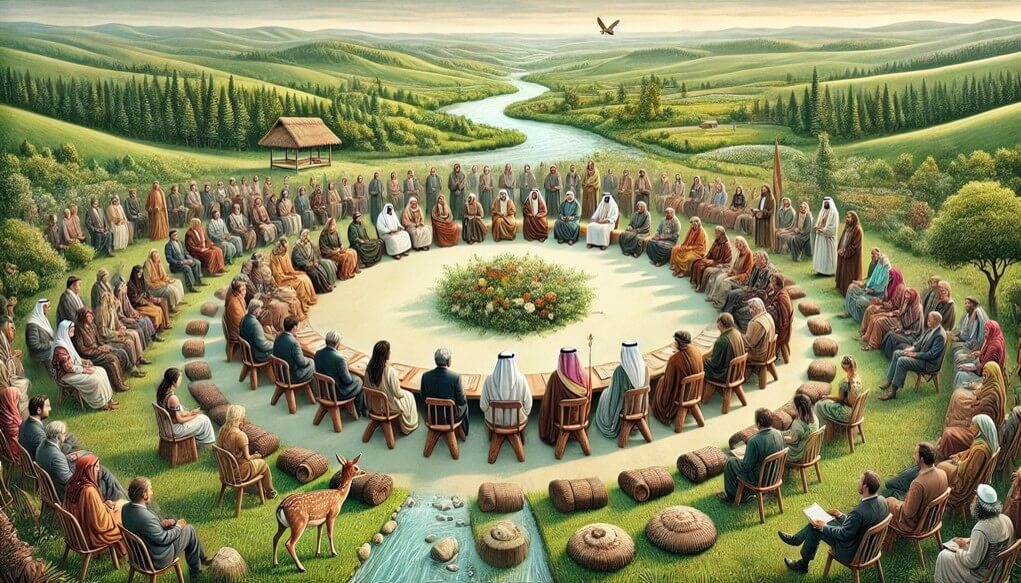
Soil, rivers, mountains, and wildlife were represented at bioregional councils
The Rise of Bioregions
By the second half of the 21st century, the political landscape shifted dramatically as bioregions became the dominant organizational structure of governance. Defined by natural boundaries—such as watersheds, ecosystems, and climatic zones—bioregions prioritized harmony with the environment, cultural respect, and local autonomy. This transformation was essential to humanity’s adaptation to climate change and resource scarcity, marking the end of centralized, nation-state dominance and the rise of ecologically and culturally aligned polities. “Bioregions teach us that our boundaries are not political but ecological,” said Tomás Quispe, a bioregional coordinator for the Pachamama Alliance in the Andes. This approach fostered local resilience while connecting communities in a global network of shared values.
They worked collaboratively to address transboundary challenges such as migratory species protection, ocean health, and climate change. All bioregions adhered to principles of ecological integrity, equity, and the long-term well-being of natural and human systems. Bioregions traded surplus energy, knowledge, and goods sustainably, ensuring mutual prosperity and resilience.
By 2045, the world had embraced bioregionalism as a guiding framework for sustainable living and ecological governance. Bioregions were defined by natural boundaries such as watersheds, ecosystems, and climatic zones, rather than political borders. Between 2035 and 2100, these bioregions became hubs of ecological restoration, cultural revitalization, and resource management. Below is a list of major bioregions and their defining features:
1. Amazonia: Encompassing the Amazon rainforest and its tributaries, Amazonia remained the planet’s largest tropical forest and a vital carbon sink. Amazonia was governed as a collective trust and forest guardian-ship, led by Indigenous councils that ensured that the forest’s bio-diversity and carbon-capturing capacity were maintained for the planet’s benefit. Restoration projects reintroduced extinct species and revived Indigenous agroforestry systems.By 2080, Amazonia’s regrowth reached 70% of its pre-20th-century coverage, and it became a hub for natural medicine research. Sustainable agriculture integrated with native ecosystems, producing exports like cacao and Brazil nuts without harming the forest canopy. Amazonia became a hub for international ecological diplomacy, hosting summits on climate adaptation and biodiversity preservation.
2. The Great Plains (North America): Spanning from Canada to Mexico, the Great Plains were transformed into a mosaic of restored prairies, grass-lands, and bison habitats. Regenerative grazing and indigenous food systems flourished here.This bioregion was a model for carbon seques-tration through soil restoration.
3. The Sahel (Africa): A semi-arid transition zone south of the Sahara, the Sahel was revitalized through massive reforestation efforts, including the Great Green Wall project. Drought-resistant agriculture and water retention systems supported local communities.The Sahel became a thriving bioregion, with restored grasslands supporting migratory bird routes and drought-resilient agriculture. Ancient Indigenous water-harvesting techniques, combined with modern innovations, secured water access and turned arid lands into biodiverse oases. Sahelian arts, crafts, and music flourished as bioregional identity became a source of pride and community cohesion.
4. The Himalayan Plateau: This region, including parts of Tibet, Nepal, and Bhutan, became known for glacial conservation and mountain agri-culture. Sacred rivers like the Ganges and Brahmaputra were protected through community-led initiatives.By 2050, the Himalayan forests served as a sanctuary for snow leopards and other endangered species.
5. Coral Triangle (Southeast Asia and Pacific): Covering Indonesia, the Philippines, and Malaysia, this bioregion housed the world’s most biodiverse marine ecosystems. Marine sanctuaries and community-led coral restoration were central features. Sustainable fisheries and mangrove replanting programs revitalized local economies.
6. Arctic Bioregion: The Arctic Circle was at the forefront of climate adaptation, with projects focused on permafrost preservation and marine biodiversity. Inuit-led governance systems ensured sustainable use of resources. By 2090, polar bear populations stabilized, and renewable energy projects powered Arctic communities.
7. The Mekong Basin (Southeast Asia): Encompassing the Mekong River and its surrounding forests, this bioregion supported rice cultivation, freshwater fisheries, and floodplain ecosystems. Agroecological systems combined ancient rice terraces with modern irrigation.
8. The Congo Basin (Central Africa): The Congo Basin was the second-largest rainforest on Earth, providing crucial habitat for gorillas, elephants, and thousands of endemic species. Sustainable logging bans and ecotourism brought economic growth while preserving biodiversity.
9. Polynesia and Micronesia (Pacific Islands): This bioregion included island chains rich in cultural heritage and marine biodiversity. Traditional seafaring and agroforestry were revived. Rising sea levels were mitigated through floating infrastructure and coral reef restoration.
10. Mediterranean Basin: Known for its climate-resilient agriculture, the Mediterranean focused on olives, grapes, and biodiversity hotspots. Ancient terraces were restored to combat soil erosion. By 2065, it became a global leader in permaculture and carbon-neutral tourism.
11. The Boreal Forests (Taiga): Stretching across Canada, Russia, and Scandinavia, these forests were critical for carbon storage and wildlife habitats. Indigenous fire management practices reduced wildfire intensity, preserving biodiversity.
12. Patagonia (South America): Known for its windswept steppes and glaciers, Patagonia prioritized conservation of its unique ecosystems and rewilding programs.By 2080, the region saw the return of species like the guanaco and Andean condor.
13. The Australian Outback: This vast bioregion became a global model for water conservation and fire-adapted ecosystems. Aboriginal land management practices were central to its restoration.The Outback’s biodiversity and cultural heritage thrived under Indigenous stewardship.
14. European Green Corridor: This bioregion spanned interconnected forests and rivers across Europe. Rewilding efforts included the reintroduction of wolves and lynxes.By 2070, the corridor linked ecosystems from the Alps to the Carpathians.
15. Antarctica: As global warming slowed, Antarctica’s unique ecosystems were preserved through strict conservation policies and global scientific cooperation. Marine reserves supported krill populations, crucial for the planet’s food chains.
16. Cascadia (Northwest North America): Spanning parts of present-day British Columbia, Washington, and Oregon, Cascadia focused on restoring forests, rivers, and salmon populations. Its governance model, inspired by Indigenous stewardship, included seasonal councils where natural cycles dictated decision-making priorities. Cascadia became a global leader in tidal and geothermal energy, providing clean energy not only locally but to nearby bioregions through interconnected grids. Cities like Portland and Vancouver integrated fully with surrounding eco-systems, creating urban food forests, wildlife corridors, and zero-waste infrastructures.
17. Oceania (Worldwide): The world’s roughly seventy-six seas constituted a mega bioregion encompassing many smaller ecosystems. From the Aegean to the Tasman, from the Coral to the Mediterranean, and from the Gulf of Alaska to the Bay of Biscay, common initiatives were undertaken to remove plastic, clean up former oil rigs and spills, and restore wildlife. By 2050, the Coral Renaissance project successfully revived the Great Barrier Reef—once thought to be beyond saving. Indigenous leader Nyoka Warragul of the Wulgurukaba people summarized the achievement during the Ocean Restoration Summit: “The reef is more than coral; it is the heart of our waters, the keeper of stories, and the mother of life. Its return is our greatest victory, proof that we can heal what we once harmed.”
Recognizing the Personhood of Nature
By the mid-21st century, the movement to grant legal personhood to elements of nature gained global momentum, reshaping governance and humanity’s relationship with the natural world. This movement, initially pioneered in New Zealand and Oceania, challenged the anthropocentric worldview embedded in legal systems worldwide. It offered an alternative to the concept of corporate personhood, which had dominated legal frameworks for over two centuries, prioritizing profit over ecological and social wellbeing.
The concept began to take root when the Whanganui River in New Zealand was granted legal personhood in 2017, recognized as Te Awa Tupua—a living entity with intrinsic value and rights. This groundbreaking legislation included the establishment of guardians to act on the river’s behalf, blending indigenous Maori traditions with modern law. Building on this success, other natural entities, such as the Ganges and Yamuna rivers in India, followed suit. By the 2030s, legal personhood for soil, rivers, mountains, and ecosystems had become a global movement, driven by escalating environmental crises and growing recognition of indigenous ecological wisdom.
By the 2050s, over fifty countries had adopted legal frameworks granting personhood to natural entities. This shift often involved constitutional amend-ments and the creation of new legal structures to represent the interests of flora and fauna. In some regions, this transformation was so profound that it resulted in the establishment of a new fourth branch of government—a “Parliament of Birds and Animals” or “Council of Plants,” as it was often dubbed. These bodies collaborated with existing executive, legislative, and judicial branches, ensuring that decisions considered the voices of non-human entities. Members of these councils included scientists, indigenous leaders, conservationists, and environmental advocates, who served as proxies for the natural world.
Examples of Legal Personhood Around the World
The United States: The Mississippi River’s Personhood in 2076
During the tricentennial celebrations in 2076, the United States formally recognized the Mississippi River as a legal entity. This historic moment marked a turning point in the nation’s environ-mental policy and cultural identity. The river was granted rights to maintain its ecological health, including protections against pollution, overextraction, and habitat destruction. Celebrations erupted along the river’s length, from Minne-sota to Louisiana, drawing millions of visitors who participated in festivals, river clean-ups, and ceremonies honoring indigenous traditions. The Mississippi River Guardians, a coalition of tribal leaders, ecologists, and legal advocates, were appointed to safeguard the river’s rights. A flotilla of new solar-powered riverboats, named Huckleberry Finn, Tom Sawyer, Jim, and Becky Thatcher after Mark Twain’s immortal characters, highlighted the festivities. Native American ceremonies, 19th century pioneer reenactors, and square dancing to fiddle music extended the length and breadth of Old Muddy. “The tricentennial is not just a celebration of our nation’s history but of a new chapter where rivers, mountains, and ecosystems stand shoulder-to-shoulder with humanity in our courts and councils,” said Sophia Hartwell, legal scholar and advocate for the Mississippi Guardians.

Tricentennial celebrations along the Mississippi
- The Amazon Rainforest: A Collective Voice for the Lungs of the Earth In South America, the Amazon Rainforest was granted personhood by a coalition of Amazonian nations in 2045. Governed by a multinational Council of the Forest, this body worked to protect the rainforest from deforestation, mining, and illegal logging. The council incorporated representatives from indigenous tribes, biologists, and international environmental organizations. The legal recognition of the Amazon as a living entity drastically reduced deforestation rates and empowered indigenous communities to play a central role in conservation efforts.
- The Himalayas: Guardians of the Sacred Peaks In 2058, Nepal, India, and Bhutan collaborated to grant personhood to the Himalayan Mountain range, referred to as “Mother Himalaya.” This legislation established a transnational council to address threats from climate change, mining, and tourism. Drawing inspiration from Buddhist and Hindu principles, the council emphasized the spiritual significance of the Himalayas and sought to restore the delicate balance of its ecosystems. “Mother Himalaya has always been a source of strength and wisdom. Recognizing her personhood is a spiritual and legal duty, ensuring her sanctity for the generations to come,” stated Kiran Sharma, Himalayan Council member.
Destructive Legislation Blocked
- The Pacific Deep-Sea Mining Proposal (Oceania, 2070): A coalition of island nations, supported by the newly formed Pacific Ocean Council, successfully blocked a multinational corporation’s plan to mine deep-sea resources. The council argued that mining violated the ocean’s right to maintain its biodiversity and ecosystem integrity.
- Mesoamerican Aquaculture Network (Panama, 2050): An attempt to expand aquaculture in the Isthmus of Panama was blocked after the Mesoamerican Biological Corridor objected to its potentially damaging impact on the Panama Canal. The Corridor presented evidence that the expansion would breach the flora and fauna around the natural land bridge from South to North America and interfere with species that used the corridor in migrating between Colombia and the southern states of Mexico.
- Northern Pipeline Project (Canada, 2068): Indigenous groups and the Council for the Boreal Forest successfully prevented the construction of an oil pipeline through protected forests. The council argued that the pipeline violated the forest’s personhood, particularly its right to habitat preservation for the species it housed.
- Green Sahara Initiative (Africa, 2072): A well-intentioned but poorly planned project to terraform parts of the Sahara Desert was blocked by the Sahel Desert Council. They argued the initiative disrupted natural desert ecosystems and failed to respect the desert’s right to exist in its natural state.
As nature’s rights gained traction, the legal doctrine of corporate personhood began to wane. By the 2070s, many nations had repealed laws granting corpora-tions the same rights as individuals. Instead, laws emphasized corporate Ac- countability to both human and non-human entities. The recognition of nature’s rights led to stricter environmental regulations and innovative economic models that prioritized sustainability over profit.
The establishment of nature’s legal personhood represented a profound shift in humanity’s worldview, one that recognized the interconnectedness of all life forms. This movement bridged ancient indigenous wisdom with contemporary governance, fostering a global culture of respect and responsibility for the Earth. By the mid-21st century, humanity had begun to see itself not as the master of nature but as its steward, ensuring a legacy of balance and harmony for genera-tions to come.
Seven Generations Principle
The governance model also embraced the Seven Generations Principle, inspired by Native American traditions, which required leaders to consider the long-term impact of decisions on future generations of humans, animals, plants, and ecosystems.
Bioregions adopted measures to prevent overexploitation of resources, ensuring their availability for generations to come. Revenues from resource use were reinvested in long-term environmental recovery projects. Bioregions incorporated teachings about intergenerational responsibility into education systems, fostering a culture of deep ecological respect.
The New Harmony: Welfare of Natural Beings
By 2100, the welfare of animals, plants, and ecosystems became an integral part of governance and daily life. Wildlife sanctuaries, rewilding programs, and species-specific councils ensured that all creatures thrived in their habitats. Rare and endangered plant species were preserved through seed banks, rewilding projects, and botanical sanctuaries integrated into urban and rural areas. Rivers were restored to natural flows, and oceans were protected from overfishing through marine bioregions managing migratory routes and ecosystems.
The rise of bioregions and the recognition of nature’s agency created a profoundly interconnected world. Humans no longer saw themselves as separate from the Earth but as one part of its intricate web of life. By weaving cultural wisdom, ecological science, and ethical governance, bioregions created a thriving, resilient planet where nature and humanity coexisted in balance, offering a sustainable blueprint for the future.